Early piglet vaccination with UNISTRAIN® PRRS induces similar neutralizing titres than 3-week-old vaccination
Adapted from the publication of Laia Aguirre et al. in the IPVS 2024. et al. in the IPVS 2024.
Introduction
In some farms, the piglet vaccination strategy against PRRSV is based on early vaccination (during the first week of life). However, at such an early age, the levels of maternally derived immunity are higher than those around weaning, which increases the risk of interference with the vaccine response.
To address this issue, Laia Aguirre and colleagues1,assessed the levels of Neutralizing Antibodies (NA) induced by two different PRRS1 Modified Live Vaccines (MLVs) when administered at 3 days of age, compared to vaccination at 3 weeks of age.
Material and methods
The trial took place simultaneously in two different commercial swine farms (Figure 1).
-
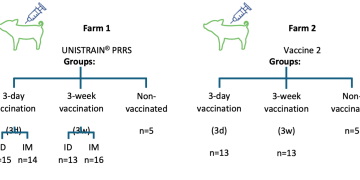
Figure 1 – Design of the study: groups according to the vaccination protocol for each farm. Adapted from Aguirre et al, 2024.
Farm 1 routinely vaccinated sows with UNISTRAIN® PRRS (strain VP-046 BIS) three times per year. In this farm, a group of 29 piglets was vaccinated with UNISTRAIN® PRRS at 3 days of age (3d): 15 were intradermally (ID) vaccinated, the remaining 14 piglets were intramuscularly (IM) vaccinated. Another group of 31 piglets was vaccinated with UNISTRAIN® PRRS vaccine at 3 weeks of age (3w): 13 ID vaccinated and 16 IM vaccinated.
In Farm 2, sows were routinely vaccinated with a different vaccine (Vaccine 2 – strain 96V198) three times per year. In this farm, 13 piglets were IM vaccinated with Vaccine 2 at 3d and 13 piglets were vaccinated IM at 3w.
In each farm, 5 non-vaccinated animals were kept as controls and, in all groups, sera were collected at 3, 21, 28 and 56 days of age to assess the homologous titres of NA.
Results
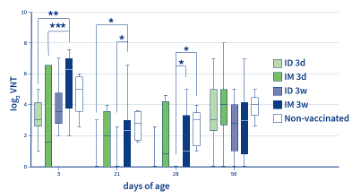
Figure 2 – Homologous neutralization titres (log2) in animals vaccinated with UNISTRAIN® PRRS. Adapted from Aguirre et al, 2024.
In Farm 1 (Figure 2), all pigs had NA against UNISTRAIN® PRRS at 3d (4.1±2.1 log2). The titres decreased in all groups at 21d (0.3±0.9a for ID 3d, 1.9±1.6a, b in IM 3d, 0.4±0.9a in ID 3w, 2.1±1.9b in IM 3w and 2.7±1.1a, b in the unvaccinated group; p<0.1).
Afterward, NA increased at day 56, with log2 averages of 3.3±1.9 for ID 3d, 4.1±2.1 for IM 3d, 2.7±1.6 for ID 3w, and 2.8±2.1 for IM 3w.
No significant differences between ID and IM were detected at any date.
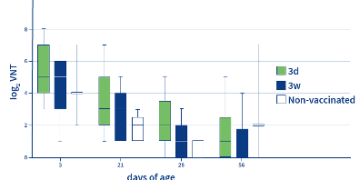
Figure 3 – Homologous neutralization titres (log2) in animals vaccinated with Vaccine 2. Adapted from Aguirre et al, 2024.
In Farm 2 (Figure 3), animals also had NA against Vaccine 2 at 3d (4.6±1.7 log2) that decreased at 21d (3.3±1.7, 2.5±1.3 and 1.8±0.8 log2 for 3d, 3w and non-vaccinated respectively). In contrast to animals vaccinated with UNISTRAIN® PRRS, NA against Vaccine 2 did not increase at day 56.
Discussion and Conclusion
The results of the present study showed that the administration of UNISTRAIN® PRRS at 3 days of age or 3 weeks of age by the IM or ID route produced similar results in terms of Neutralizing Antibodies.
For those farms where an early vaccination program is needed, UNISTRAIN® PRRS shows potential to provide an effective protection, either intramuscularly or intradermally administered.
On another hand, the capacity to overcome MDA appears to vary among vaccines: in the case of the Vaccine 2, titres did not increase after vaccination, showing lower probability of effective protection against a PRRS infection.
If you want to read more publications about PRRS: PRRS Control Publications
References
1. Aguirre L, Mergelina F, Miranda J, Ballarà I, Martín M, Mateu E. Vaccination of 3-day-old pigs with a PRRSV-1 Modified Live Vaccine induces similar neutralizing titers than 3-week-old vaccination. 27th International Pig Veterinary Society Congress (2024). Leipzig, Germany