Can PRRSV1 Modified-Live vaccines be effective against PRRSV2?
Porcine Reproductive and Respiratory Syndrome Virus (PRRSV) remains one of the toughest challenges in pig production worldwide. There are two main species of the virus: PRRSV1 (European type) and PRRSV2 (American type). Except in Europe, PRRSV2 tends to be the dominant — and often more aggressive — variant, typically causing more severe symptoms and greater production losses¹.
In some herds, both viral species can circulate at the same time, creating coinfections that can make PRRS control even more complicated². Modified-live vaccines (MLVs) are a cornerstone of PRRS prevention programs, but each vaccine only contains one of the two viral species. This raises a key question for producers and veterinarians alike: can a PRRSV1-based MLV also protect pigs against PRRSV2?
What field data from South Korea tell us
To shed light on this, Jeongjae Byun and colleagues³ conducted a study on a Korean pig farm struggling with both PRRSV1 and PRRSV2. They evaluated UNISTRAIN® PRRS, a PRRSV1-based modified-live vaccine (strain VP-046), under real-world conditions.
The farm transitioned from a farrow-to-finish to a two-site system in late 2023, and the study followed three distinct phases:
1. Non-Vaccination (Aug–Nov 2023) – The herd was positive for PRRSV2, but no vaccine was used.
2. Sow Vaccination (Nov 2023–Mar 2024) – Following an outbreak involving both PRRSV1 and PRRSV2, only breeding animals were vaccinated with UNISTRAIN® PRRS.
3. Sow and piglet Vaccination (Mar–Jun 2024) – Both sows and piglets (vaccinated at two weeks of age) received UNISTRAIN® PRRS.
Nursery mortality served as an indicator of vaccine effectiveness. The outcome was clear (table 1): while sow vaccination alone didn’t improve piglet survival, mortality dropped sharply once piglets were also vaccinated with the PRRSV1 MLV — suggesting better control of virus circulation within the herd.
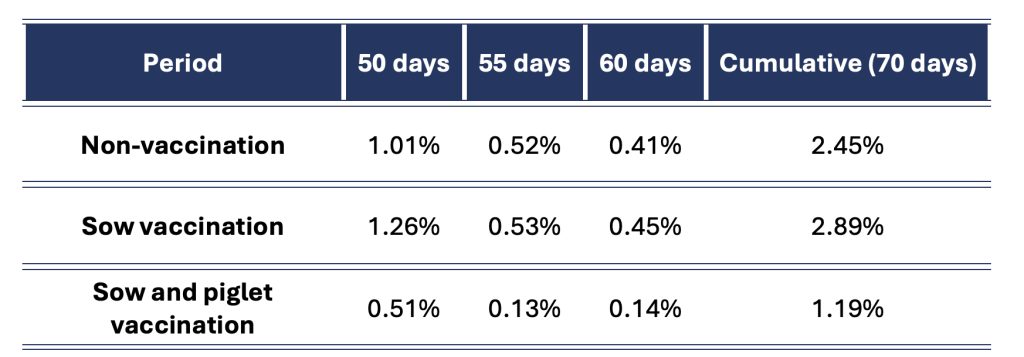
Table 1 – Comparative results of nursery mortality from the three studied periods. Adapted from Byun J et al, 2025.
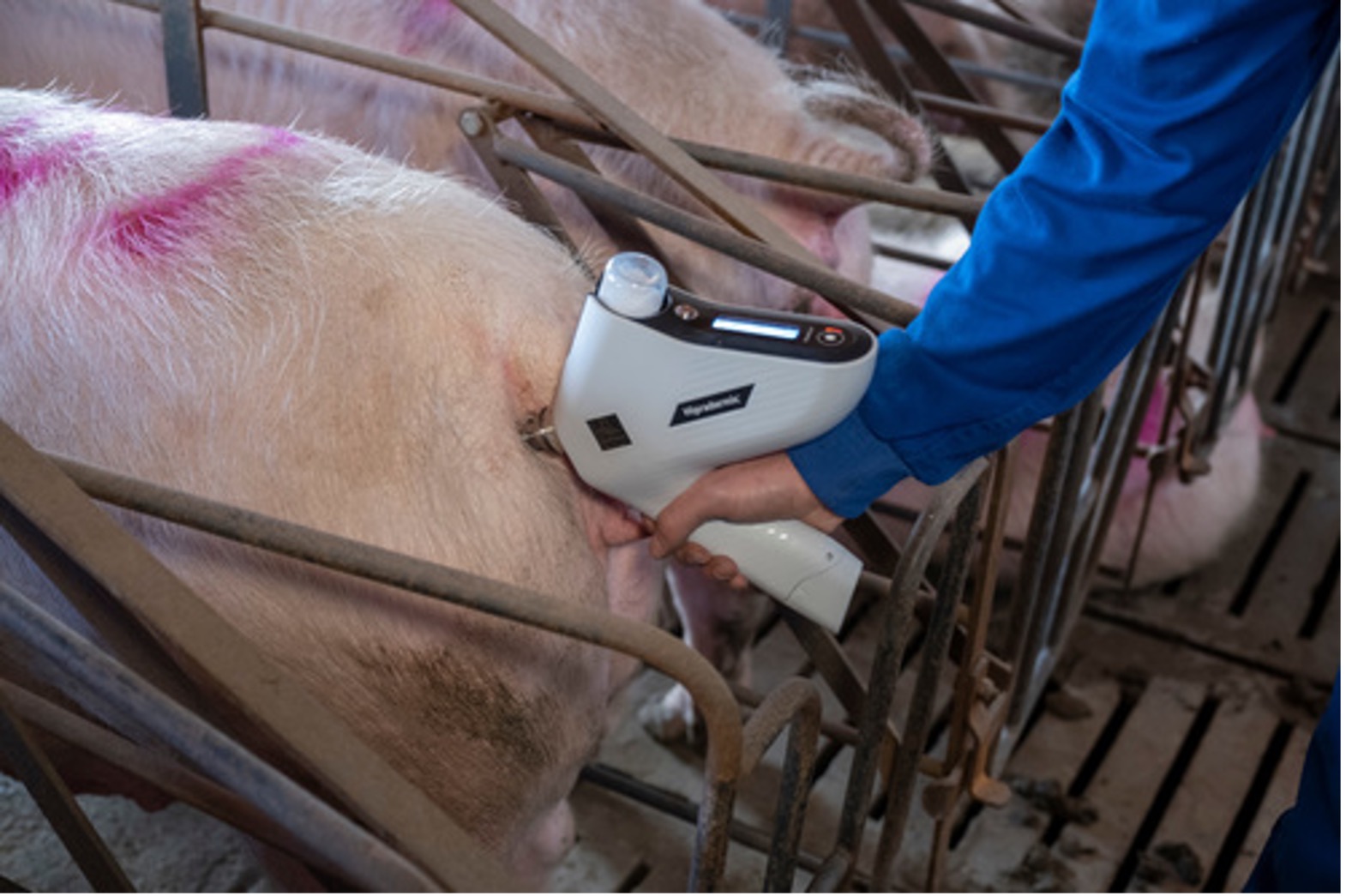
A second study by Hyun Dong Noh and colleagues⁴ looked at a site 2 and site 3 farm in South Korea that routinely introduced 70-day-old pigs from a PRRS-negative site 1. Initially, these pigs were vaccinated with a PRRSV2 MLV (VR2332, 2 ml, IM). However, after a PRRSV1 outbreak in April 2021 that caused high mortality, the farm switched to UNISTRAIN® PRRS ID — the same vaccine as in the previous study but applied intradermally using a needle-free device (HIPRADERMIC®, HIPRA).
Daily mortality data were collected for all batches, and results showed that mortality decreased significantly after switching from the PRRSV2 to the PRRSV1 vaccine, despite the ongoing presence of both virus types on the farm (graphic 1).
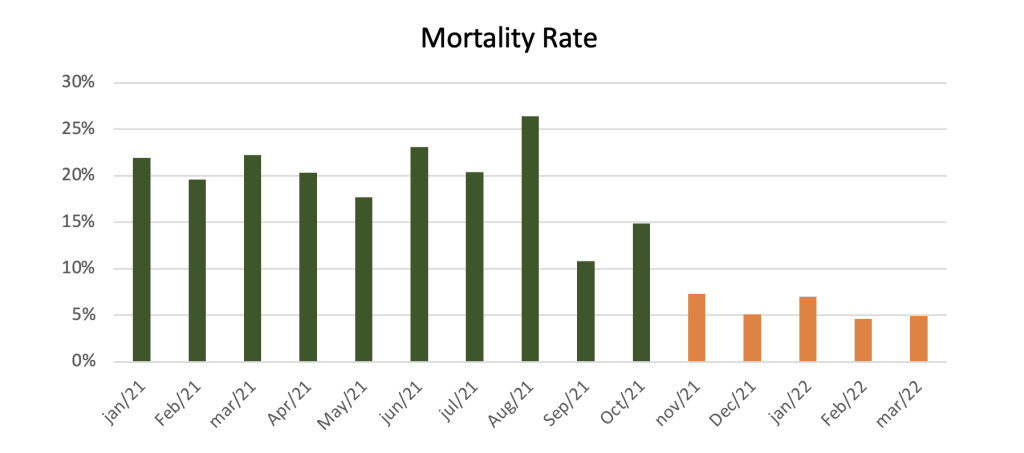
Graphic 1 – Monthly mortality (phase 2 + phase 3) of both groups: vaccinated with a PRRSV2 MLV (green) or with UNISTRAIN® PRRS (orange). The differences were statistically significant with p<0.001 (logistic regression). Adapted from Dong Noh et al, 2023.
What Does This Mean in Practice?
These real-world experiences offer valuable lessons for the field:
- A PRRSV1-based MLV like UNISTRAIN® PRRS can provide PRRSV2 cross-protection helping stabilize herd health in mixed-infection scenarios.
- In highly challenging scenarios (outbreaks and when new strains are circulating), vaccination of both sows and piglets is the most effective way to reduce nursery mortality.
- Even though sow-only vaccination did not reduce nursery mortality in this study, it has been widely proved to be a great tool to stabilize the infection.
In Summary
These Korean case studies demonstrates that vaccinating piglets with a PRRSV1-based MLV can significantly reduce mortality in farms facing both PRRSV1 and PRRSV2. These findings support including direct piglet vaccination in PRRS control strategies and show that cross-protection from PRRSV1 vaccines like UNISTRAIN® PRRS can be both practical and effective.
If you want to read more publications: PRRS Control Publications
References
1. Martínez-Lobo FJ Díez-Fuertes F Segalés J García-Artiga C Simarro I Castro JM Prieto C. Comparative pathogenicity of type 1 and type 2 isolates of porcine reproductive and respiratory syndrome virus (PRRSV) in a young pig infection model. Vet Microbiol. 2011 Dec 29;154(1-2):58-68. doi: 10.1016/j.vetmic.2011.06.025. Epub 2011 Jul 1. PMID: 21831539.
2. Taira O Fujiwara A Takai R Tsutsumi N Sugiura K. Porcine reproductive and respiratory syndrome virus type 1 and type 2 co-infection in a Japanese swine herd. J Vet Med Sci. 2025 Sep 8. doi: 10.1292/jvms.25-0279. Epub ahead of print. PMID: 40915927.
3. Byun J Dong Noh H Choi S Romero S Kim J. Efficacy of UNISTRAIN® PRRS Vaccination in Piglets for Controlling PRRSV1 and PRRSV2 Coinfection in a Korean Swine Farm. 11th Asian Pig Veterinary Society Congress (2025). Fukuoka Japan
4. Dong Noh H An K Byun J Seo S Romero S Miranda J. Comparison of mortality in a PRRS-endemic site 2 and site 3 after switching from a PRRSV2 MLV to a PRRSV1 MLV in Korea. 10th Asian Pig Veterinary Society Congress (2023). Taipei Taiwan