Optimizing pooling strategies for PRRSV surveillance
Introduction
One of the keys for controlling the impact of Porcine Reproductive and Respiratory Syndrome virus is implementing an adequate monitoring program1,2,3,4. Serum pooling from due-to-wean piglets is the recommended method by the American Association of Swine Veterinarians (AASV) for breed monitoring and PRRSV status classification1, even though it is well known that pooling may reduce the individual sensitivity of the RT-PCR test2.
Fernando de Mergelina and colleagues5,6 performed the following study to evaluate the detection limit of RT-PCR when pooling PRRSV positive serums. They used serums with different levels of viremia, measured by Cycle threshold (Ct) and simulated a dilution effect to determine the best pooling strategy while maintaining a good sensitivity.
Material and methods
A total of 47 PPRSV-1 and 33 PRRSV-2 positive serum samples were categorized into four Ct range groups: 18-25, 25-30, 30-35 and 35-38 (samples >38 Ct were considered negative).
14 PRRSV-1 samples were categorized in the 18-25 Ct group, 11 in the 25-30 Ct group, 13 in the 30-35 Ct group, and 9 in the 35-38 Ct group. For the PRRSV-2 samples, 9 were categorized in each of the Ct groups (18-25, 25-30 and 30-35); no samples belonging to the 35-38 Ct group were analyzed.
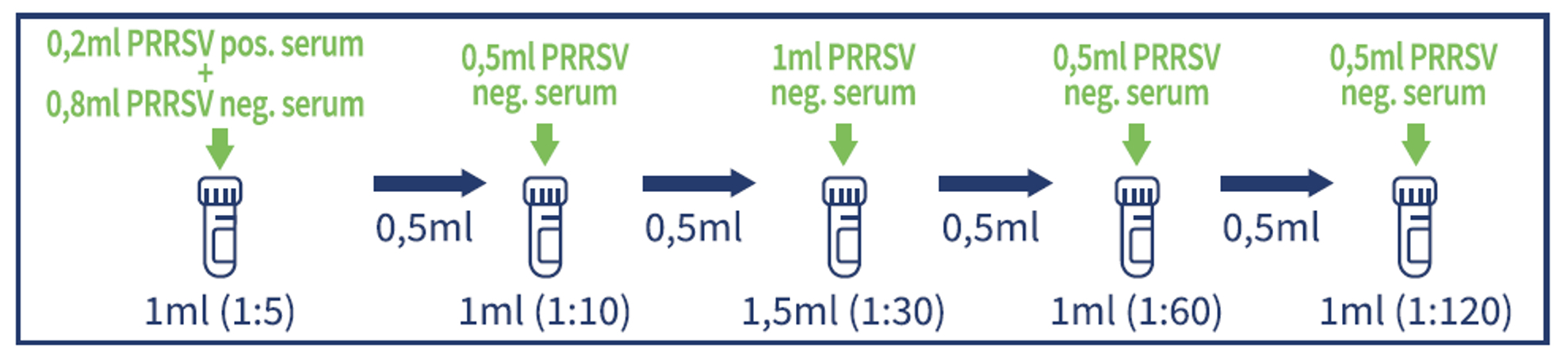
Figure 1. Dilution protocol simulating the pooling of one positive serum within pools of 5, 10, 30, 60 and 120 serums.
Samples were serial diluted simulating pools of 5, 10, 30, 60 and 120 samples (Figure 1). The RT-PCR sensitivity was estimated for each Ct group at each dilution range. Furthermore, a linear mixed model was calculated to estimate the increase in Ct values by each dilution range.
Results
Sensitivity results are represented in tables 1 and 2. Samples with Ct<30 maintained a 100% sensitivity in nearly all the dilution groups and in both virus species. On the other hand, samples with Ct>30 had a decrease in sensitivity whilst increasing the pool size in both PRRSV1 and PRRSV2.
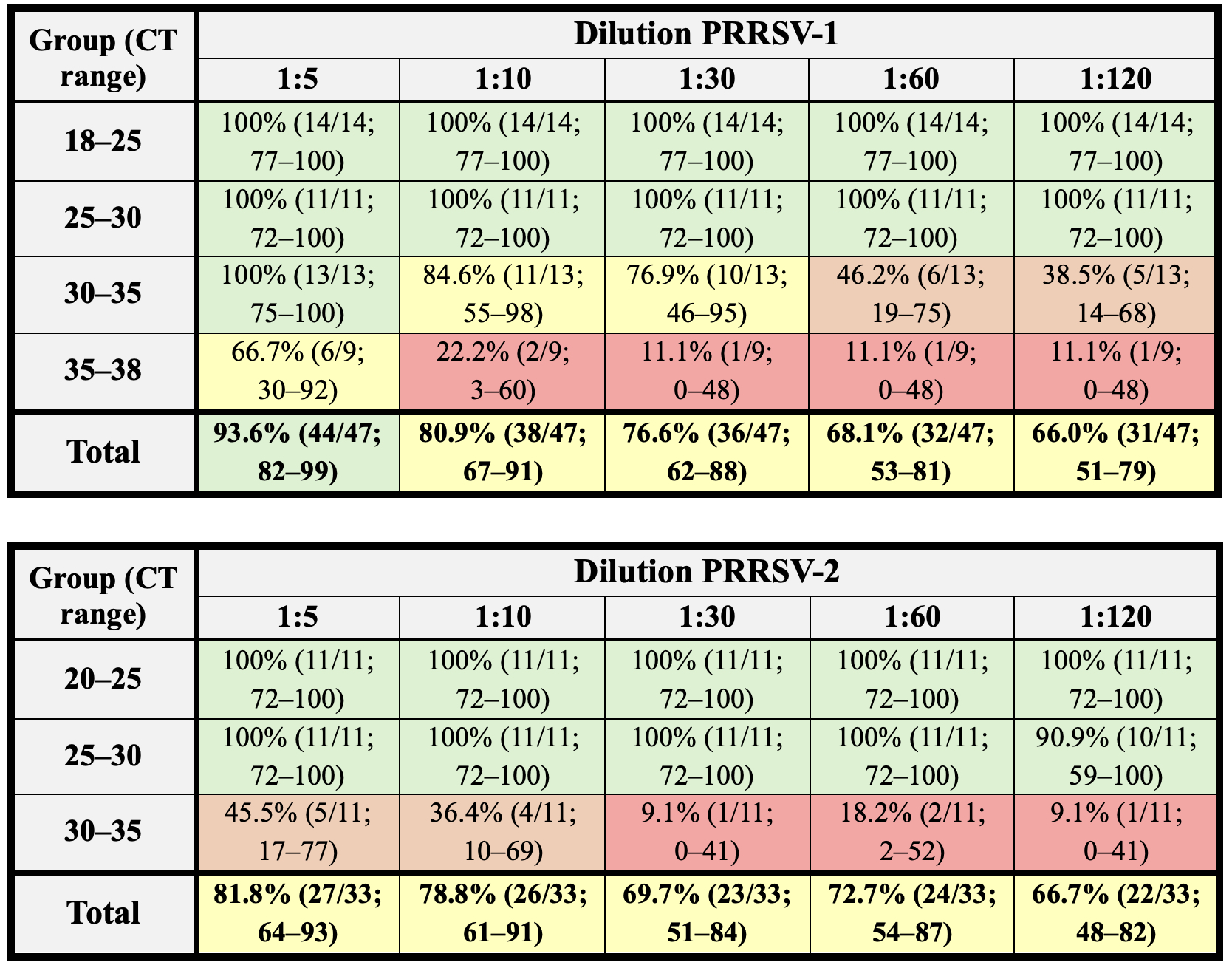
Tables 1 and 2. PRRSV-1 and PRRSV-2 sensitivity (%) by RT-PCR Ct group and dilution, number of positive samples out of the total per group, and 95% confidence interval. Color code: green for sensitivity >90%, yellow for 60-90%, orange for 30-60, and red for <30%.
The linear mixed model equations for each PRRSV species were calculated, considering sample as a random effect (Figures 2 and 3).
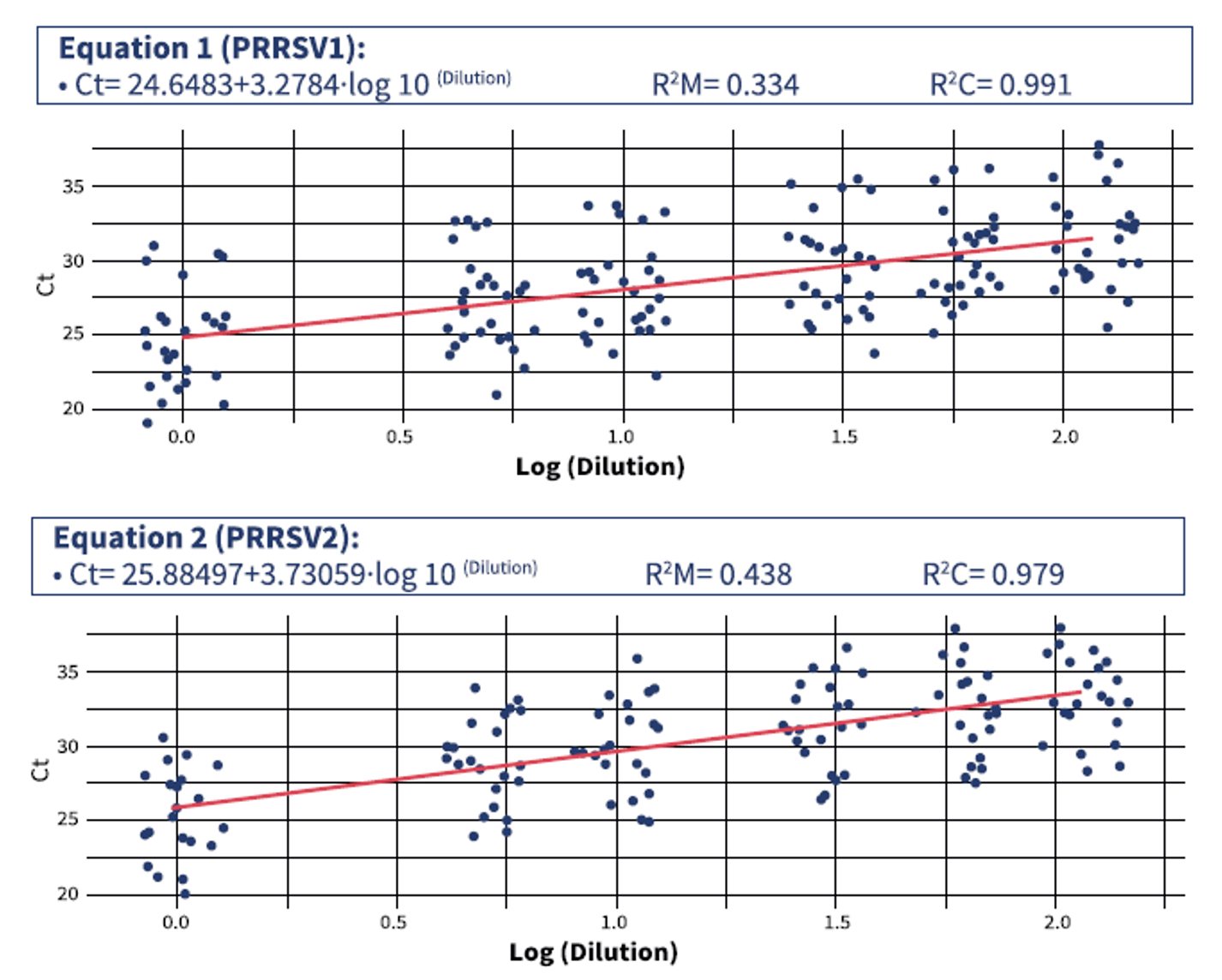
Figures 2 and 3. RT-PCR Ct values of initial and pooled serum samples, different dilutions expressed as Log10. Fitted linear mixed model for PRRSV-1 and PRRSV-2 results.
Discussion
Results from this study corroborate that the sensitivity of pooled samples depends on the viral load of the positives samples. Considering new highly pathogenic strain scenarios in some countries/regions, where infection with PRRSV results in a high viral load in serum, pooling can be a valid strategy to reduce costs and still detect the early onset of the disease.
The sensitivity results also confirm that for both PRRSV species, pooling at least 5 serums has no effect on sensitivity (if serum Ct values < 30), or a moderate effect (if serum Ct values > 30). These results are consistent with previous studies2,3,4.
Based on author’s results5,6, the maximum number of dilutions possible before considering a sample as negative (>38 Ct threshold) mainly depends on the positive sample or samples viral load. Thus, considering the worst-case scenario defined as only one positive sample with a low Ct (35), the maximum allowable dilution for PRRSV-1 and PRRSV-2 would be 1:8 and 1:6, respectively.
Serum pooling is a widely used monitoring technique as the larger sample sizes allow to monitor more animals at reduced costs. For example, in the case of boar studs monitoring, where the surveillance standard is extremely high due to the need to ensure that the centers remain PRRSV‑negative, the estimated cost of individual PRRSV surveillance testing is close to 5.19% of the total cost of a seminal dose, assuming around 25-30 euros per individual boar serum test7. Therefore, it becomes the third most significant cost after fixed costs (workers’ salaries, energy, facilities, etc.) and variable costs (feed, medication and sawdust). If pooling was implemented, costs would be lowered from 5.19% to only a 0.17% cost when applying a highly aggressive pooling strategy (120 samples per pool), or to 1.04% when using a more cautious 5‑sample pool that aims to maintain the highest balance between cost and sensitivity.
Conclusion
Understanding the PRRSV epidemiology, especially prevalence and animal viremia, and the effect of serum pooling on PRRSV RT-PCR sensitivity is key for implementing an adequate monitoring strategy that is both reliable and reduces costs. Results from this study indicate that, for both PRRSV species, the most balanced strategy is the pooling of between 5 to 10 serums, as this approach does not significantly compromise test sensitivity while still allowing to notably reduce monitoring costs.
References
1- Holtkamp, D., et al. (2021). Proposed modifications to Porcine Reproductive and Respiratory Syndrome Virus herd classification. Journal of Swine Health and Production, 29(5), 261-270.
2- Rovira A., et. al. (2007). Evaluation of the sensitivity of reverse-transcription polymerase chain reaction to detect porcine reproductive and respiratory syndrome virus on individual and pooled samples from boars. Journal of Veterinary Diagnostic Investigation,19(5), 502-509.
3- Lebret, A., et. al. (2023). Alternative samples for Porcine Reproductive and Respiratory Syndrome surveillance in an endemic PRRSV-1-infected breeding herd: A descriptive study. Veterinary Sciences, 10(9), 55.
4- Vilalta, C., et. al. (2019). Effect of litter aggregation and pooling on detection of Porcine Reproductive and Respiratory Syndrome virus in piglet processing fluids. Journal of Veterinary Diagnostic Investigation, 31(4), 625-628.
5- de Mergelina, F., et. al. (2025). Serum pooling: Making PRRSV surveillance in the boar stud affordable. 10.5281/zenodo.16077426.
6- de Mergelina, F., et. al. (2025). Optimizing Pooling Strategies for PRRSV Surveillance: RT-PCR Detection Limits for PRRSV1 and PRRSV2. 10.13140/RG.2.2.12868.49288.
7- Luongo, C., et. al. (2022). Should all fractions of the boar ejaculate be prepared for insemination rather than using the sperm-rich only? Biology, 11(2), 210. 10.3390/biology11020210